BEAUTY
  E-COMMERCE
  EDUCATION
  HEALTH
  TECHNOLOGY
  TRAVEL
Picture telling an assistant “find me a foundation that won’t turn orange on my skin and won’t look cakey by noon,” and it actually gets what you mean, checks a dozen products against it, and buys the right one, no tabs, no scrolling through reviews at midnight. That’s not a hypothetical anymore. It’s basically what Meta’s Muse and OpenAI’s ChatGPT Dots are built to do, and the two of them showing up within weeks of each other this fall has quietly changed how people shop online altogether.
What an AI Shopping Assistant Is Actually Doing Behind the Scenes
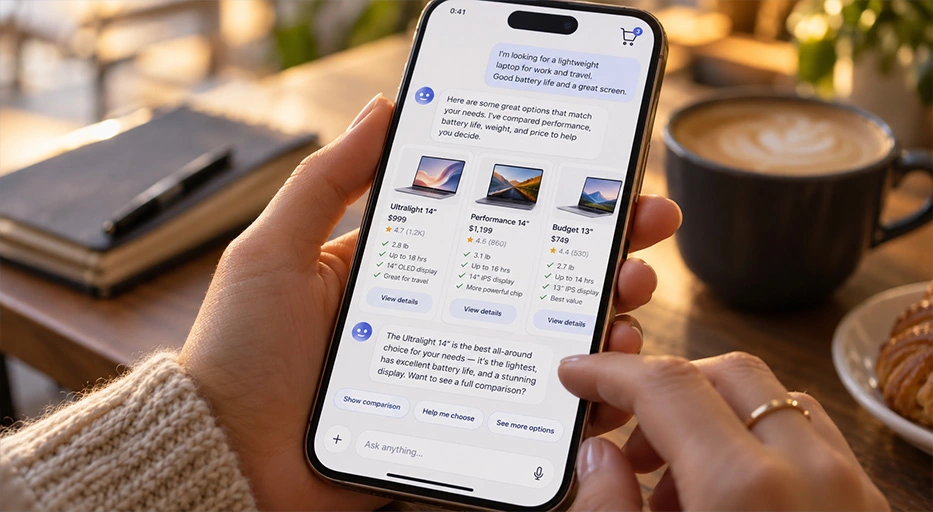
An AI shopping assistant works the way a genuinely good personal agent would, it picks up on your preferences, your budget, what you’ve bought before, then goes and searches, compares, and sometimes buys for you. Muse launched September 8, 2026, and had already crossed 2.5 million U.S. downloads by the 23rd. OpenAI followed a couple weeks later with Dots. Both sit inside a fast-moving pack of autonomous AI agents, including smaller players like Instinct, all racing to become the thing people talk to instead of typing into a search bar.
And the behavior shift isn’t theoretical. Shopify’s own data, reported by Inc., showed AI-driven shopping traffic up 8x year-over-year, AI search orders up almost 13x, and new buyers converting at nearly double the rate of regular organic search.
Not Every Store Is Letting These Agents In

Here’s where Muse and Dots actually diverge, and it matters if you’re deciding which AI shopping assistant to trust with your wallet. Muse partnered directly with Shopify, which hands it access to Shopify’s full merchant catalog plus checkout through Shop Pay and PayPal. Meta also locked down retail connectors with Best Buy, Gap, Sephora, Walmart, and Wayfair, and travel booking through Expedia, with Instacart reportedly coming soon.
Amazon said no, though. Flat-out blocked Muse from its site, claiming it wasn’t given advance notice and flagging concerns that the agent was scraping account data and skipping past the personalization Amazon built into its own shopping experience. It’s a clear sign that AI in ecommerce isn’t a done deal everyone’s agreed to; some of the biggest retailers are actively deciding who gets in the door.
Why This Is Harder for AI Than It Looks
The tricky part was never really access; it’s translation. People describe problems in plain, messy language. Product catalogs list specs. DaVinci Commerce, which helps brands make their listings legible to these agents, has a good example: someone asking for “a foundation that won’t turn orange” and someone else asking “what’s best for sensitive skin” could both end up pointed at the exact same product, even though neither phrase shows up anywhere in its actual listing.
DaVinci’s founder, Diaz Nesamoney, put it well: “Consumers describe their lives, their needs and the problems they want to solve to personal AI agents. Most product catalogs still speak in technical specifications.” That gap is exactly why brand-side AI agents exist now too: software built to represent a product and feed an AI shopping assistant the context it actually needs instead of just a spec sheet.
What This Actually Means If You’re Using One
For everyday product comparison, the upside is real. Instead of forty tabs and conflicting reviews at 1 a.m., a good AI shopping assistant can do that legwork and hand you the trade-offs in seconds. But there’s a catch worth sitting with first.
A University of Virginia Darden School of Business professor, Luca Cian, told CNBC that the real fight isn’t between you and the agent; it’s between companies scrapping over which one becomes your default, with you as the prize. Worth remembering that whichever one you pick quietly decides which brands even make your shortlist in the first place.
None of this runs on thin air, either. Tools built for AI for shopping lean on exactly the kind of compute buildout we covered in our piece on where OpenAI, Oracle, and SoftBank’s Stargate data centers actually stand today, the infrastructure race happening behind the scenes is what makes instant, agent-driven shopping possible in the first place.
Where This Leaves Things
ChatGPT Dots and Meta Muse are really two different bets on the same idea, that AI for shopping is becoming the default rather than a search engine or a browser tab full of comparison sites. Muse has moved fastest on retail partnerships, Shopify, Walmart, Expedia, all locked in, while getting shut out of Amazon entirely. But the bigger shift sitting underneath both tools is this: product comparison is quietly turning into a negotiation between two autonomous AI agents, one representing you, one representing the brand, happening before you ever actually see a product page.
Frequently Asked Questions
A personal agent, like Meta Muse or ChatGPT Dots, shops on your behalf, learning your preferences and comparing options. A brand agent represents a company’s products, feeding AI systems structured data so the right products actually get recommended.
No. Amazon blocked Muse from its platform, citing concerns over unauthorized data access and the agent bypassing Amazon’s built-in shopping features.
Muse has confirmed partnerships with Shopify, Walmart, Best Buy, Gap, Sephora, Wayfair, and Expedia, with Instacart integration reportedly on the way.
Shopify reported an 8x year-over-year jump in AI-driven shopping traffic, with AI search orders up nearly 13x compared to the year before.
It can be, since these tools translate plain-language needs into actual product matches, but accuracy really depends on how well a brand’s product data is structured for AI systems to read in the first place.