BEAUTY
  E-COMMERCE
  EDUCATION
  HEALTH
  TECHNOLOGY
  TRAVEL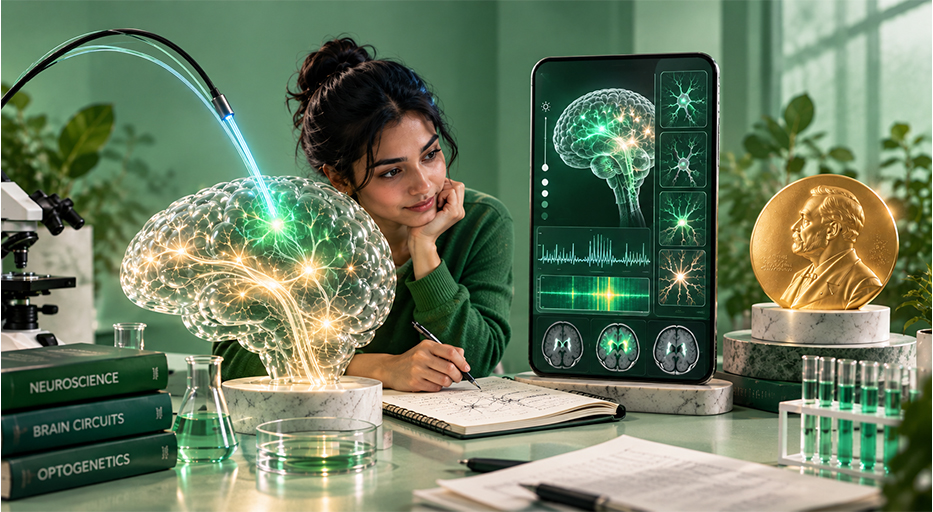
Ever wondered how the incredibly complex network of neurons in the human brain generates our thoughts, feelings, and every single action we take?
Brain research used to have a massive precision problem. Scientists could watch millions of neurons fire at once, but isolating just one was like trying to whisper to a single person in a screaming stadium. They could observe the noise, but they couldn’t turn down the volume or play a single note on demand.
Those days of frustratingly broad tools are officially over.
The Nobel Prize in Medicine for 2026 has been awarded to the pioneers of optogenetics research. This revolutionary technique has fundamentally changed the game, giving scientists an exquisite level of control that was once the stuff of science fiction.
The Power of Lighting Up the Brain

So, what is it? Optogenetics is a brilliant fusion of genetic engineering and optical technology. Scientists have found a way to make specific neurons in the human brain light-sensitive.
Believe it or not, this entire revolution started with single-celled green algae (Chlamydomonas). Nobel laureates Peter Hegemann and Georg Nagel discovered that these tiny algae contain a light-sensitive protein called channelrhodopsin that helps them swim toward sunlight. By introducing the gene for this algal protein into mammalian neurons, Karl Deisseroth and his team unlocked a universal light switch for brain cells.
By delivering precise pulses of light through fine optical fibers, researchers can now flip individual neurons ‘on’ or ‘off’ with millisecond precision. It’s like installing a light switch for brain cells, and it’s transformed brain research from a game of observation into a science of precise manipulation.
The impact has been profound. We are now mapping the precise circuits that control everything from simple movements to complex emotional states, memory formation, and decision-making.
“A transformative tool that has allowed us, for the first time, to establish causal links between specific neural activity and behavior,” stated the Nobel Assembly at Karolinska Institutet in its announcement of the Nobel Prize in Physiology for 2026.
The Brain-Behavior Revolution
Before this breakthrough, understanding the intricate relationship between brain and behavior was a massive challenge. Traditional methods like electrical stimulation were too blunt, exciting everything in their path.
Optogenetics changed everything.
It let scientists isolate a single neuron type and see exactly how it influences an animal’s actions. The insights gained from this precise control are fueling a new era of brain research.
- Causal Connections: For the first time, we can prove that a specific group of neurons causes a particular action or feeling.
- Circuit Mapping: We are creating a functional map of the brain, understanding how different regions communicate and coordinate.
- Disease Insights: By controlling the relevant circuits, we are gaining unprecedented insights into neurological and psychiatric disorders.
Beyond the Lab: A Shimmer of Hope
The potential clinical applications of this Nobel-winning technique are perhaps its most exciting aspect. While most optogenetics studies currently take place in research models, the findings are paving the way for future therapies that could one day help people suffering from a wide range of debilitating conditions.
Imagine the possibilities:
- Restoring Vision: Researchers are exploring optogenetic approaches to restore sight by making other cells in the eye sensitive to light.
- Treating Parkinson’s: Precisely targeted light pulses could one day help modulate the abnormal brain activity that causes tremors and motor issues.
- Alleviating Depression: By identifying and stimulating the exact circuits involved in mood regulation, new treatments for severe depression could be developed.
The Medicine Nobel Prize 2026 doesn’t just celebrate an incredibly cool technique; it marks a pivotal moment in human history. With optogenetics, we have a new key to unlock the brain’s most profound secrets, offering new hope for more effective treatments for some of our most challenging health conditions. The future of understanding ourselves is looking brighter than ever.
Frequently Asked Questions
It involves using light to stimulate the activity of neurons engineered to respond to light. The discovery earned its inventors the Nobel Prize in Physiology or Medicine for enabling precise manipulation of neural circuits during brain experiments.
Traditional methods like deep brain stimulation use electrical currents that excite all nearby cells nonselectively. Optogenetics is highly precise, allowing researchers to target only one neuron type and turn it on or off at will with millisecond timing.
It has allowed scientists to establish direct causal links between specific groups of neurons in the human brain and behavior. This has revolutionized our understanding of complex functions like memory, emotion, and decision-making.